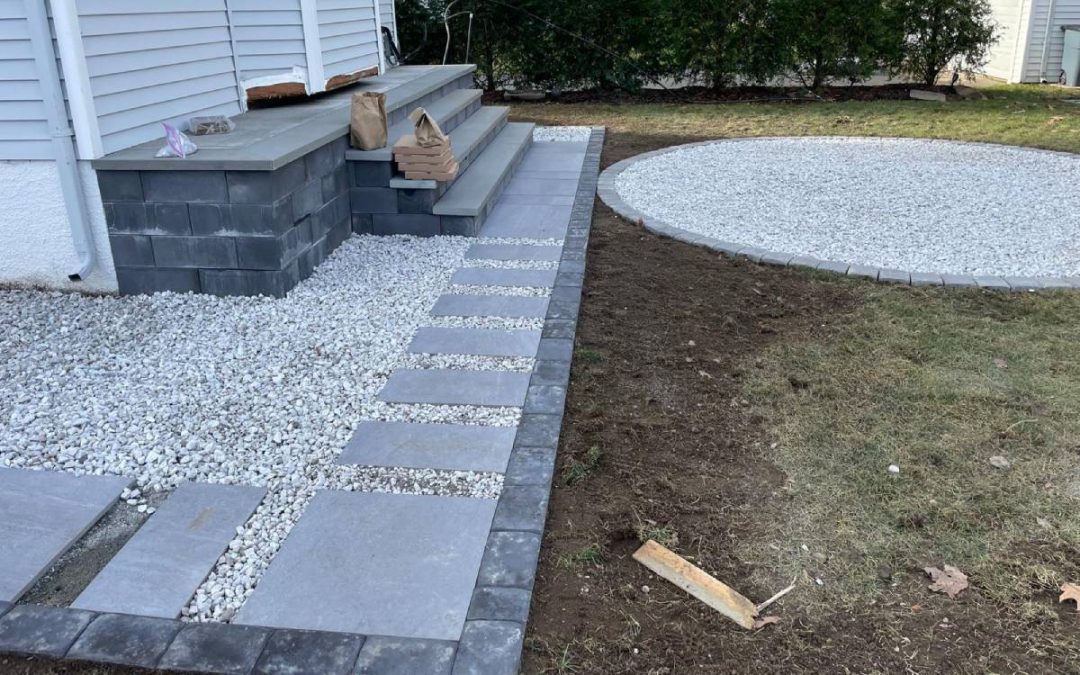
Short answer: most homeowners pay $20 to $40 per square foot for a professionally installed patio on Long Island in 2026, which works out to roughly $6,000 to $16,000 for a typical 200–500 square foot patio. Concrete pavers sit in the middle of that range; poured concrete is cheaper, and natural stone like bluestone is at the top. The real number depends on the material you choose, the size and shape, how much site prep your yard needs, and any features like a fire pit or sitting wall. Below is the full 2026 breakdown and the only way to get an exact figure is a free, measured, on-site quote.
Patio Cost Per Square Foot on Long Island (2026, by material)
Material is the single biggest driver of price. Here’s what each option typically costs installed on Long Island, including base, labor, and finishing:
| Material | Typical installed cost / sq ft | Best for |
|---|---|---|
| Poured concrete | $12–$25 | Lowest upfront cost; more prone to cracking here |
| Concrete pavers (standard) | $20–$30 | Best all-around value and design range |
| Concrete pavers (premium / patterned) | $28–$40 | High-end look, borders, multi-color patterns |
| Brick | $20–$35 | Traditional and historic homes |
| Travertine | $25–$45 | Pool patios; stays cooler underfoot |
| Porcelain pavers | $30–$50 | Modern, low-maintenance, fade-resistant |
| Bluestone | $30–$50 | Premium Northeast natural-stone look |
| Natural flagstone | $30–$55 | Fully custom, organic shapes |
Patio Cost by Size (concrete pavers, mid-range)
To turn price-per-square-foot into a real budget, here are typical all-in totals for a standard paver patio at roughly $25–$35 per square foot:
| Patio size | Typical installed total (pavers) |
|---|---|
| 200 sq ft (small) | $5,000–$7,000 |
| 300 sq ft (average) | $7,500–$10,500 |
| 400 sq ft (large) | $10,000–$14,000 |
| 600 sq ft (extra-large) | $15,000–$21,000 |
Larger patios usually cost less per square foot because fixed costs like mobilization and excavation are spread over more area.
What’s Included in the Price
A proper patio quote on Long Island should cover all of this not just “pavers and labor.” When you compare estimates, make sure each one includes: excavation and haul-away of spoil, the compacted crushed-stone base, base compaction, bedding sand, the pavers or stone, edge restraints, polymeric jointing sand, a final compaction pass, and site cleanup. If a quote is missing the base depth or the jointing, it isn’t the same job it’s a cheaper, shorter-lived one.
8 Factors That Change Your Patio Price
Two patios on the same Long Island street can price very differently. The main variables:
- Size and shape — curves and irregular layouts need more cutting and labor than a simple rectangle.
- Material — concrete pavers are the value pick; bluestone, travertine, and porcelain are premium.
- Base and grading — sloped yards, poor drainage, or soft soil need more excavation and base work.
- Site access — if machines can’t reach the backyard, material is moved by hand, which adds labor.
- Demolition — removing an old concrete slab or deck adds $2–$6 per square foot.
- Pattern complexity — herringbone, basket-weave, and contrasting borders take longer than running bond.
- Drainage solutions — added drains or regrading to move water away from the home.
- Add-on features — walls, fire pits, steps, and lighting (see next section).
Add-On Feature Costs
Most patio projects on Long Island include at least one upgrade. Typical added costs:
| Feature | Typical added cost |
|---|---|
| Built-in fire pit | $1,500–$5,000 |
| Sitting / seat wall | $60–$120 per linear ft |
| Steps | $300–$800 per step |
| Pool coping | $40–$70 per linear ft |
| Landscape lighting | $80–$200 per fixture |
| Outdoor kitchen | $5,000–$20,000+ |
| Old slab / patio removal | $2–$6 per sq ft |
Pavers vs. Concrete: Which Costs Less Over Time?
Poured concrete is cheaper to install, but on Long Island it tends to crack as the ground freezes and thaws, and a cracked slab usually has to be torn out and replaced. Pavers cost more upfront but flex with frost, and if a section is ever damaged you can lift and replace individual units instead of redoing the whole patio. Over a 15–20 year horizon, a paver patio often costs less per year of use which is why most of our Long Island customers choose pavers. See the full comparison on our patio installation page.
Why the Cheapest Quote Usually Costs the Most
The most expensive patio is the one you pay for twice. The lowball quotes we see on Long Island almost always save money by cutting the part you can’t see: a 2-inch sand base instead of a 6-inch compacted stone base, no polymeric sand in the joints, and no edge restraint. Those patios look fine for a season, then heave, settle, and sprout weeds within a couple of winters. A correctly built base costs more on day one and is the entire reason a patio is still flat ten years later.
Do You Need a Permit, and Does It Cost Extra?
Depending on the scope especially with retaining walls or structures a patio may require a town permit. Permit fees vary by town, and a good contractor folds the paperwork into the project so you’re not chasing forms at town hall. We handle permits as part of the job.
How to Budget and Pay for a Patio
Get at least two or three written, itemized estimates and compare them line by line base depth, material, jointing, and warranty, not just the bottom number. Build in a small contingency (5–10%) for surprises once the ground is opened up. And ask whether the contractor offers financing if you’d rather spread the cost over time.
Get a Free, Itemized Patio Estimate on Long Island
Islandwide Paving & Masonry is an owner-operated paving and masonry company based at 3120 NY-112, Medford, NY 11763, serving Suffolk and Nassau County. Owner William measures your space in person, walks you through materials, and gives you a written, itemized estimate free, with no obligation and no phone-guess pricing. We hold a 5.0-star rating from 30 Google reviews. Call 631 710 1995, email info@islandwidepavingli.com, or request your free estimate online. Local to Medford? See our Medford paving services. We also build matching walkways and stoops and steps.
Frequently Asked Questions
How much does a patio cost on Long Island in 2026?
Most professionally installed patios run $20–$40 per square foot, or about $6,000–$16,000 for a typical 200–500 square foot patio. Concrete pavers fall in the middle; poured concrete is cheaper and natural stone like bluestone is premium.
What is the cheapest patio material?
Poured concrete is the lowest upfront cost at roughly $12–$25 per square foot installed, but it’s more prone to cracking in Long Island’s freeze-thaw climate. Concrete pavers cost a bit more but last longer and are repairable.
How much does a 300 square foot paver patio cost?
A standard 300 square foot paver patio typically runs $7,500–$10,500 installed, depending on the paver line, pattern, and site preparation.
Why are paver patios more expensive than concrete?
Pavers cost more upfront because of the material and the labor-intensive base and jointing. The payoff is longevity: they flex with frost instead of cracking, and individual units can be replaced, so they often cost less over their lifespan here.
Does a patio add value to my home?
A well-built patio expands usable outdoor living space and improves curb appeal, both of which support resale value on Long Island. Quality of construction and how well it integrates with the yard matter more than size alone.
Why is the base so important to the price?
The compacted crushed-stone base and polymeric-sand joints are what keep a patio from heaving, settling, and growing weeds. They’re the most important part of the price cutting them is how lowball quotes fail within a few winters.