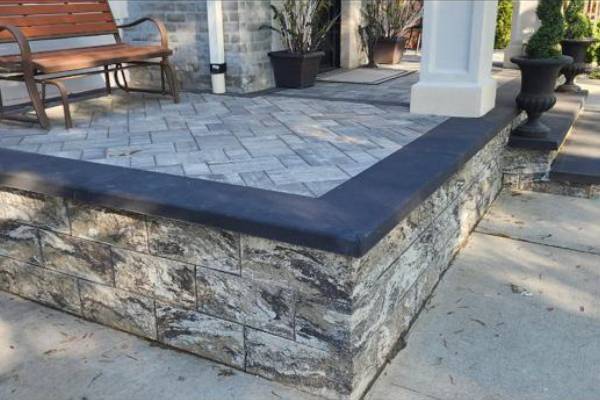
Islandwide Paving & Masonry designs and installs paver, bluestone, travertine, and natural-stone patios across Long Island handling the design, the base, the drainage, and the finish so your patio stays dead level through decades of freeze-thaw winters. We’re an owner-operated company based in Medford; owner William is on-site for every job, every project starts with a free on-site design consultation and a written, itemized estimate, and we hold a 5.0-star rating from 30 Google reviews. Licensed and insured across Suffolk and Nassau County.
Patio Materials We Install on Long Island
The right material depends on your home, your budget, and how the space will be used. Here’s how the main options perform in our climate:
Concrete Pavers
The most popular and most versatile choice on Long Island. Pavers come in hundreds of colors, shapes, and patterns, they’re the best value of the premium materials, and critically for our freeze-thaw winters each unit flexes independently instead of cracking the way a poured slab does. Premium lines from manufacturers like Cambridge and Techo-Bloc give you a high-end look with a manufacturer warranty.
Bluestone
The classic Northeast natural stone strong, slip-resistant, and timeless next to traditional Long Island homes. A premium look with a very long lifespan.
Travertine
A premium natural stone that stays noticeably cooler underfoot in summer, a favorite for pool patios and sunny entertaining areas.
Porcelain Pavers
Low-maintenance, fade- and stain-resistant, and available in large-format modern looks. An excellent choice for contemporary homes.
Brick & Other Natural Stone
Brick suits traditional and historic homes and pairs naturally with matching stoops and walkways. We also work in flagstone and fieldstone for fully custom designs.
How We Build a Patio That Survives Long Island Winters
A patio is only as good as what you can’t see. The base not the surface is what decides whether it stays flat or heaves and settles after a couple of winters. Here’s how we build:
- Excavation: we dig out 8–10 inches so there’s room for a proper base, not a token few inches of sand.
- Compacted stone base: 6 inches of 3/4-inch crushed stone, compacted in lifts with a plate compactor the layer that prevents future heaving and sinking.
- Bedding & setting: a screeded bedding layer, then the pavers or stone set tight to the pattern.
- Polymeric sand joints: swept into the joints and activated so they lock the field together and stop weeds and ants from rooting in the cracks.
- Edge restraint & slope: a locked edge restraint plus a deliberate slope away from your home so water never pools or runs toward the foundation.
This is the same freeze-thaw engineering that governs a quality driveway. Industry standards from the Concrete Masonry & Hardscapes Association confirm what we see in the field: base preparation and proper joints determine a patio’s lifespan far more than the surface material.
Patio Patterns & Custom Design
Every patio starts with a free on-site design consultation. We bring real material samples and lay out the pattern to match your home herringbone, running bond, basket-weave, large-format, with contrasting soldier-course borders and banding. Because we also do masonry, we can integrate a sitting wall, fire-pit area, steps, or a matching walkway and stoop so the whole property reads as one design.
Pool Patios & Pool Surrounds
We build slip-resistant pool patios and surrounds with coordinated coping for a clean transition between water and hardscape. Travertine and textured pavers are popular here because they stay cooler underfoot and grip well when wet. If you’re building or renovating a pool, we coordinate the patio on the same schedule.
How Much Does Patio Installation Cost on Long Island?
Patio cost is driven by size, the material you choose (pavers are the value option; bluestone and travertine are premium), how much site preparation and grading the yard needs, and any added features like a sitting wall or fire pit. Because every yard is different, the only accurate number is a measured, on-site quote which we provide free and in writing, fully itemized so you can see exactly what you’re paying for. For a detailed breakdown of what drives the price, see our Long Island patio cost guide.
Permits & Local Know-How
Depending on the scope, a patio especially one with retaining walls or structures may require a permit from your town. We work under local rules every week and handle the paperwork so you avoid a stop-work order or fine.
Why Long Island Homeowners Choose Islandwide
Owner William is on-site, not just on the phone, and we self-perform every patio with our own crew rather than handing it to a subcontractor, so quality and scheduling stay under one roof. Customers consistently describe the work as fast, fairly priced, and detail-focused: tight, even joints, a true slope for drainage, and clean transitions to walkways, steps, and pool areas. Most residential patios are installed in two to five days, and we hold a 5.0-star rating from 30 Google reviews. See finished work in our project gallery.
“Took two days and completely redid my driveway and back patio. Very happy with the work they did.” – Paul Lucenti
“Had my driveway and my pool done by Islandwide Paving and Masonry. William is very genuine and knowledgeable.” – Can Gunes
Read more verified reviews on our Google Business Profile.
Areas We Serve on Long Island
We install patios across Long Island from our Medford headquarters at 3120 NY-112, serving homeowners throughout Suffolk and Nassau County. See our local Medford paving services, or call 631 710 1995 to schedule your free design consultation.
Frequently Asked Questions
How much does patio installation cost on Long Island?
Cost depends on size, material, site preparation, and added features, so the only accurate figure is a measured on-site quote. We provide free, written, itemized estimates across Suffolk and Nassau County.
What is the best patio material for Long Island?
Concrete pavers offer the best combination of value, design range, and freeze-thaw performance. Bluestone and travertine are premium natural-stone options; porcelain suits modern homes. All perform well over a properly compacted base.
How long does patio installation take?
Most residential patios are installed in two to five days depending on size and material. Combined patio-and-walkway or patio-and-driveway projects can run on one continuous schedule.
Do pavers crack in Long Island winters?
Properly installed over a 6-inch compacted base with polymeric sand joints, pavers flex with freeze-thaw cycles instead of cracking like a poured slab, that’s their main advantage here.
Are pavers better than a poured concrete patio?
For our climate, usually yes. Pavers flex with frost, individual units can be lifted and replaced if needed, and they don’t show the wide cracks a slab eventually develops. Concrete can cost less upfront but is more prone to cracking on Long Island.
Do I need a permit for a patio?
Sometimes it depends on the scope and whether walls or structures are involved. We confirm the requirement with your town and handle the permit paperwork for you.
Do you build pool patios and surrounds?
Yes. We install slip-resistant pool patios with coordinated coping, and we can schedule the patio alongside a new or renovated pool.