Long Island Asphalt & Paving Snapshot
A certified paving contractor on Long Island must adapt asphalt mixes to withstand severe coastal freeze-thaw cycles and comply with New York state consumer laws. Leading installations utilize PG 64-22 binder, warm-mix asphalt technology, and laser-guided grading to secure code-compliant, long-lasting structural durability.
When hiring a paving contractor on Long Island, property owners need more than a crew with a roller and a truck. They need a fully compliant asphalt infrastructure specialist who understands Nassau and Suffolk County soil conditions, NYS consumer protection laws, drainage regulations, and modern asphalt engineering standards.
Whether you need residential driveway paving, commercial parking lot resurfacing, or industrial blacktop restoration, long-term performance starts below the surface.
At Islandwide Paving LI, we deliver engineered asphalt solutions designed for Long Island’s climate, municipal code requirements, and heavy-use durability expectations.
2026 New York State Regulations: Licensing, Deposits & Legal Compliance
Choosing the right paving contractor on Long Island starts with legal compliance.
In 2026, New York State continues enforcing stricter contractor protections for residential and commercial exterior construction projects. Hiring an uninsured or non-compliant paving company can create serious financial and legal risks for homeowners and property managers.
NYS Deposit Protection Rule
Under the New York State Home Improvement Contractor Law, contractors are legally limited to collecting no more than:
10% of the total project cost OR $500 – whichever is less
This rule protects consumers from large upfront deposits and fraudulent contractor practices.
Any paving company demanding large cash deposits before excavation, delivery, or asphalt placement should raise immediate concern.
At Islandwide Paving LI, every contract includes:
-
Clear project dimensions
-
Asphalt thickness specifications
-
Base preparation details
-
Payment milestones tied to actual work completion
-
Fully licensed and insured project documentation
We serve Nassau and Suffolk Counties with transparent pricing and code-compliant contracts that protect your investment.
Advanced 2026 Asphalt Technology: WMA, PG 64-22 & Thermal Imaging
Modern asphalt paving is an engineering discipline not simply blacktop installation.
Our paving systems use advanced materials and technology to improve durability, sustainability, and structural lifespan across Long Island.
1. Warm-Mix Asphalt (WMA) Technology
We install Warm-Mix Asphalt (WMA) systems following technical guidance supported by the Asphalt Institute.
Unlike traditional hot mix asphalt, WMA uses specialized additives that allow asphalt to be produced and installed at temperatures 30°F to 70°F lower.
Benefits include:
-
Improved compaction during spring and fall installs
-
Reduced thermal cracking over time
-
Lower emissions during production
-
Better workability and finish consistency
-
Longer installation windows during cooler months
For Long Island driveways and parking lots, WMA creates stronger, more flexible pavement with improved long-term performance.
This is why many warm-mix asphalt contractors in NY now prioritize WMA systems over standard hot mix.
2. Performance Grade (PG) 64-22 Binder
Long Island’s climate requires asphalt that performs during both humid summers and freezing winters.
We specify PG 64-22 asphalt binder for residential and commercial paving projects.
This engineering-grade binder is designed to:
-
Resist rutting during 90°F+ summer temperatures
-
Maintain flexibility during winter freeze-thaw cycles
-
Prevent premature cracking
-
Improve asphalt longevity under traffic loads
PG 64-22 is one of the most important quality indicators when selecting a Nassau County paving company.
Cheap asphalt often fails because contractors use lower-performance binder grades.
3. GPS-Guided Grading & Thermal Imaging Verification
Surface appearance means nothing without proper drainage and compaction.
That is why we use advanced field technology to verify structural performance during every installation.
GPS-Guided Grade Controls
Our excavation and grading equipment uses GPS-guided leveling systems to establish precise pitch and water flow management.
This ensures:
-
Proper drainage away from homes
-
Parking lot runoff control
-
Reduced standing water
-
Prevention of edge failure
-
Long-term base stability
Thermal Imaging for Compaction Quality
During asphalt placement, our project supervisors use infrared thermal imaging to detect cold spots during compaction.
Cold spots cause weak areas and premature cracking.
Thermal verification allows us to identify and correct those areas immediately before final rolling.
This creates:
-
Uniform asphalt density
-
Better compaction rates
-
Longer pavement life
-
Stronger structural integrity
This technology separates professional paving contractors from basic blacktop installers.
NYS DEC Stormwater Compliance & SPDES Permit Requirements
Large-scale paving projects must also comply with environmental regulations.
The New York State Department of Environmental Conservation (NYS DEC) enforces the SPDES General Permit GP-0-25-001 for stormwater discharges associated with construction activities.
This is especially important for:
-
Commercial parking lots
-
Industrial paving projects
-
Shopping centers
-
Warehouse facilities
-
Developments disturbing over one acre of land
These projects may require:
-
SWPPP (Stormwater Pollution Prevention Plans)
-
eNOI permit submissions
-
MS4 runoff compliance
-
Erosion and sediment controls
-
Post-construction drainage planning
Commercial blacktop projects in Suffolk County often trigger these requirements.
Ignoring stormwater compliance can result in permit delays, violations, and major project costs.
Soil Engineering: North Shore Clay vs. South Shore Sand
A strong asphalt surface is only as good as the foundation underneath it.
Long Island is divided into two major geological zones that require different paving strategies.
North Shore: Clay Loam & Frost Heaving
Areas like Huntington, Oyster Bay, Port Jefferson, and Manhasset sit on dense glacial moraine made of clay-heavy soils and buried stone.
Clay traps water.
When that water freezes, it expands upward and causes frost heaving—one of the most common reasons for cracked driveways and failed blacktop.
To prevent this, our North Shore installations require:
-
Deep excavation up to 12 inches
-
High-density RCA stone base
-
Commercial geotextile stabilization fabric
-
Laser grading for drainage correction
-
Frost-zone moisture management
This protects Long Island asphalt driveway installation projects from cracking and upheaval.
South Shore: Sandy Soil & High Water Tables
Communities like Massapequa, Babylon, Patchogue, and Rockville Centre sit on sandy outwash plains with high groundwater levels.
Sand drains quickly, but it shifts under heavy loads.
Without proper stabilization, vehicles create rutting, edge failure, and settlement cracks.
Our South Shore paving systems include:
-
Reinforced aggregate sub-base layers
-
High-density compaction
-
Edge restraints for load transfer
-
Water table drainage planning
-
Load-zone stabilization for trucks and SUVs
Every neighborhood requires a different structural plan.
That is why true local blacktop repair specialists understand Long Island geology first.
Residential vs Commercial Asphalt Standards
Residential driveway paving and commercial parking lots require very different structural specifications.
Residential Driveway Paving
Typically includes:
-
6–8 inches excavation
-
4–6 inches compacted RCA base
-
2–3 inches finish asphalt
-
15–25 year lifespan with maintenance
Ideal for:
-
Single-family homes
-
Multi-car driveways
-
Residential driveway resurfacing 117 projects
-
Apron replacements and curb transitions
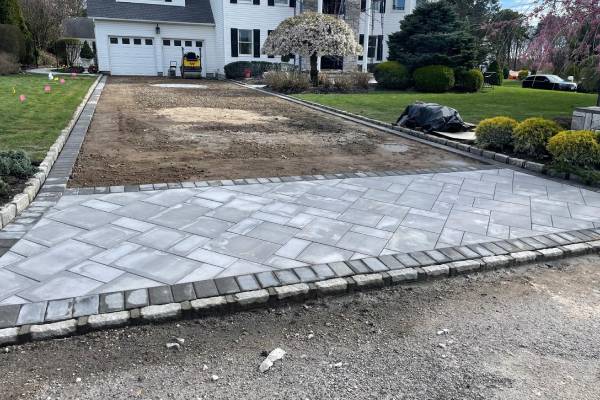
Many homeowners also combine paving upgrades with custom patio installation and stone border services for full curb appeal improvement.
Commercial Parking Lot Paving
Typically includes:
-
10–12 inches excavation
-
6–8 inches heavy-duty aggregate base
-
Binder and top asphalt lifts
-
Full drainage and runoff planning
-
SWPPP review when required
Ideal for:
-
Retail centers
-
Office complexes
-
Apartment developments
-
Commercial blacktop Suffolk NY projects
We also provide commercial sealcoating and crack filling services to protect long-term asphalt investments.
The Islandwide Paving Execution Framework
Our paving process is designed for structural performance—not shortcuts.
Phase 1: Utility Verification & Site Mapping
We coordinate with DigSafelyNY (811) and perform topographic measurements before excavation begins.
Phase 2: Excavation & Grade Alignment
We remove failed asphalt and excavate to stable soil conditions while setting drainage pitch.
Phase 3: RCA Sub-Base Installation
We install compacted recycled concrete aggregate for long-term structural support.
Phase 4: Warm-Mix Asphalt Placement
Our paving machines install custom WMA asphalt mixes at engineered thickness levels.
Phase 5: Multi-Pass Rolling & Thermal Verification
Heavy tandem rollers and thermal cameras ensure total compaction and density consistency.
Phase 6: Final Edge Support & Sign-Off
We complete edge compaction, cleanup, and final inspection with full project review.
This process creates asphalt systems built to perform for decades.
Paving Contractor Long Island FAQs
What is the legal deposit limit for paving projects in New York?
Contractors may only collect 10% of the total project cost or $500, whichever is less, as an upfront deposit under NYS Home Improvement Law.
What is the difference between asphalt overlay and full reconstruction?
An overlay adds new asphalt over an existing structurally sound base. Full reconstruction removes failed asphalt and repairs the foundation when cracking, sinking, or alligator cracking is present.
Why is Warm-Mix Asphalt better?
WMA allows better compaction, reduced thermal cracking, lower emissions, and improved performance during Long Island’s cooler paving seasons.
How long before I can drive on new asphalt?
Most driveways require 3 to 5 days before vehicle traffic. Hot summer conditions may require slightly longer curing times.
Do driveway replacements require permits?
Simple replacements often do not, but widening a driveway, replacing an apron, or changing a curb cut usually requires municipal approval.
What causes alligator cracking?
Alligator cracking is caused by failed sub-base support, water intrusion, and structural fatigue not simple surface wear.
Request Your Free Asphalt Consultation
If you are searching for a trusted paving contractor on Long Island, success begins with engineering, compliance, and material quality.
From residential driveway resurfacing to large-scale commercial blacktop systems, Islandwide Paving LI delivers asphalt infrastructure built for Long Island conditions.
We provide:
-
Residential driveway paving
-
Commercial asphalt installation
-
Industrial paving systems
-
Sealcoating and crack repair
-
Patio and masonry integration
-
Full excavation and drainage planning
To schedule your free estimate, visit our Long Island paving consultation page today.