Choosing a paving company on Long Island is one of those decisions that looks simple until you start getting estimates that are thousands of dollars apart for what sounds like the same job. The short version: the right paving company is licensed in Suffolk or Nassau County, insured, locally based, and willing to put the base depth and asphalt thickness in writing not just a bottom-line number. The cheapest quote is almost never the best value, because the part that determines whether your driveway lasts twenty years or cracks in two is the work you can’t see. This guide walks through exactly how to vet a Long Island paving company in 2026, what quality work costs, the scams to avoid, and the questions that separate a real contractor from a seasonal operator. It’s written by the team at Islandwide Paving & Masonry, an owner-operated company based in Medford, NY.
What Does a Paving Company on Long Island Actually Do?
“Paving company” is a broad term on Long Island, and knowing the full scope helps you match the right contractor to your project. Most established Long Island paving companies handle three overlapping areas of work. The first is residential paving: asphalt and paver driveways, patios, walkways, pool surrounds, and aprons. The second is commercial paving: parking lots, private roads, loading areas, sealcoating, and line striping for businesses. The third is masonry and hardscaping: retaining walls, stoops and steps, stone veneer, and repointing, which many full-service companies fold in because the same crews build them. A company that self-performs across these areas can coordinate a driveway, walkway, and steps on one schedule instead of juggling three subcontractors.
Within each area, a paving company does more than lay a surface. The real job is site preparation: excavation, grading for drainage, building and compacting the stone base, and only then installing the finished asphalt, concrete, or pavers. Repair and maintenance crack filling, resurfacing, sealcoating, and pothole patching round out the services, and a good company will tell you honestly when a repair will do instead of pushing a full replacement.
Why Choosing the Right Paving Company Matters on Long Island
Long Island’s climate is unusually hard on pavement. We run through dozens of freeze-thaw cycles every winter: water seeps into a hairline crack or a weak base, freezes overnight, expands by roughly nine percent, and pries the surface apart a little more each season. Add salt, summer heat, and the sandy soil of the outwash plain, and you have conditions that punish shortcuts mercilessly. A driveway or lot built to survive that begins with four to six inches of compacted crushed-stone base, two to three inches of properly rolled hot-mix asphalt, and edges graded so water runs off instead of pooling.
This is why the choice of company matters so much more here than in a milder climate. Two contractors can quote the “same” driveway, but one is planning a proper excavation and compacted base while the other is planning to lay a thin mat over whatever is already there. Both driveways look identical the week they’re finished. One is still flat in fifteen years; the other is cracking by the second spring. The National Asphalt Pavement Association is unambiguous that base preparation and compaction determine pavement life far more than the surface course. Your job as a buyer is to figure out which kind of company you’re actually talking to and the rest of this guide is about exactly that.
The 9-Point Checklist to Vet a Long Island Paving Company
Run every contractor through this list before you sign anything. It quickly separates established local companies from the operators who disappear after the first crack appears.
1. Confirm the license. Home improvement contractors on Long Island must be licensed by the county. Ask for the number and verify it through the Suffolk County Department of Labor, Licensing & Consumer Affairs or the Nassau County Office of Consumer Affairs. A legitimate company hands the number over without hesitation.
2. Verify insurance. Ask for a current certificate of insurance showing general liability and workers’ compensation. If a worker is injured on your property and the company isn’t covered, the liability can land on you.
3. Demand a written, itemized estimate. It should state the base depth (four to six inches of compacted stone for a driveway), the asphalt thickness (two to three inches of hot-mix), the drainage plan, and the total price. A one-line quote on the back of a business card tells you nothing and protects you even less.
4. Ask who actually does the work. A company that self-performs with its own crew controls quality and scheduling. One that brokers your job to whatever subcontractor is available cannot make the same promise. This is worth asking directly.
5. Review a local portfolio. Ask to see recent jobs in your area, Medford, Patchogue, Ronkonkoma, wherever you are and drive by one if you can. Photos are good; an address you can look at is better.
6. Read the reviews carefully. Look past the star rating to the detail. Reviews that name specific towns, describe the crew’s behavior, and mention base prep or drainage are far more credible than a wall of one-line “great job” entries. Be a little skeptical of dozens of reviews posted the same week.
7. Get the warranty in writing. A confident contractor stands behind the work with a written workmanship warranty. Ask what it covers and for how long.
8. Understand the payment terms. A reasonable deposit with the balance due on completion is standard. Full payment demanded upfront or a cash-only insistence is a warning sign.
9. Check for a real, local presence. A physical address, a local phone number, and a company that has worked your area for years all matter. A contractor rooted on Long Island can be held accountable in a way that a truck passing through cannot.
Does the Company Own Commercial-Grade Equipment?
Here’s a question most homeowners never think to ask, and it’s one of the most revealing: does the company own its equipment, or rent it job by job? A professional paving company runs commercial-grade gear a mechanical paving machine (not a crew hand-raking hot-mix off the back of a dump truck), a vibratory steel-drum roller for proper compaction, a plate compactor for edges and tight spots, and a skid steer or excavator for base preparation and grading. Machine-laid asphalt is smoother, more uniform, and better compacted than hand-laid work, with fewer voids where water can get in. When a company owns its equipment, its crew knows how to run it, maintain it, and use it efficiently. When they’re renting for the first time, you’re paying for their learning curve with your driveway. Ask directly, the answer tells you a lot about who you’re dealing with.
Red Flags and Common Paving Scams on Long Island
Paving has a well-earned reputation for a specific kind of scam, and Long Island sees it every season. The classic is the door-to-door “leftover asphalt” pitch: someone knocks and says they just finished a job nearby and have extra material they’ll lay cheap today only. What you get is a thin layer of low-grade asphalt over an unprepared base, no permit, no warranty, and no company to call when it fails within a year. Walk away from it every time.
Other warning signs worth taking seriously: a quote given over the phone without a site visit; pressure to decide immediately; a price dramatically below every other estimate; a demand for full payment or cash upfront; no written contract; no verifiable license or insurance; and no physical business address. Any one of these should give you pause. Two or more, and you should keep looking. Cheap paving is the most expensive kind, because you pay for it twice, once for the failed job and again to tear it out and do it right.
How to Compare Paving Estimates: Specs, Not Just Price
This is where most homeowners go wrong. When three estimates come back at $4,500, $6,000, and $7,000, the instinct is to assume they’re bids on the same job and pick the cheapest. They almost never are. A $4,500 quote for two inches of asphalt laid over your existing gravel is simply not the same product as a $7,000 quote for full excavation, eight inches of compacted aggregate base, and three inches of hot-mix even though both say “new driveway” at the top. The cheaper one looks fine on day one and is cracking by the second winter; the thorough one is still flat in twenty years. So don’t compare the bottom line compare the specifications line by line: excavation depth, base material and thickness, asphalt thickness, drainage plan, edge treatment, and warranty. When you line the quotes up that way, the “expensive” one is often the only one that’s actually a fair price for a driveway that lasts. A reputable Long Island paving company will happily walk you through why their number is what it is.
Residential vs. Commercial Paving Companies
Not every Long Island paving company is set up for every job. Residential work driveways, patios, walkways, pool surrounds rewards craftsmanship, clean edges, and design sense, and it’s usually completed in one to a few days. Commercial work parking lots, private roads, sealcoating and striping programs rewards scale, scheduling around a business’s operating hours, ADA compliance, and the equipment to move a lot of material fast. Plenty of established companies do both, but it’s worth confirming that a contractor has real experience with your specific project type. A crew that mostly paves parking lots may not bring the same finish detail to a curved paver driveway, and vice versa.
Asphalt vs. Concrete vs. Pavers: Which Is Right for Your Project?
A good paving company helps you choose the right material rather than selling you the one they prefer to install. Here’s how the three main options compare on Long Island:
| Material | Installed cost / sq ft (2026) | Lifespan on Long Island | Best for |
|---|---|---|---|
| Asphalt | $5–$12 | 15–20 years | Most driveways; freeze-thaw value |
| Concrete | $10–$20 | 25–30 years | Decorative finishes; milder spots |
| Pavers | $20–$40 | 30+ years | Premium driveways, patios, walkways |
Asphalt is the value pick and handles our freeze-thaw winters by flexing rather than cracking. Concrete lasts longer in milder conditions but is more prone to cracking here and costs more upfront. Pavers are the premium, longest-lasting, most design-flexible choice and can be repaired unit by unit. For most Long Island driveways, asphalt delivers the best balance but a paving company worth hiring will walk you through the trade-offs for your specific property.
The Base Is Everything: What Proper Prep Actually Looks Like
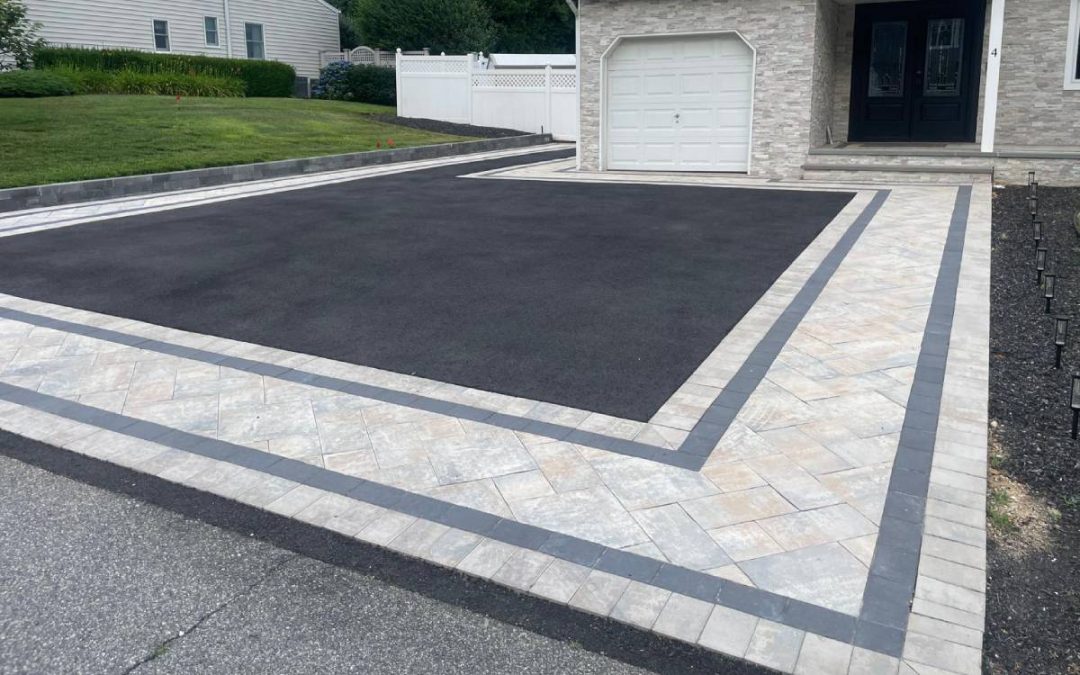
If you remember one thing from this guide, make it this: the base beneath your pavement matters more than the surface on top of it. A flawless asphalt surface laid over a poor base will fail; a competent surface over a properly built base lasts twenty years or more. That’s not marketing it’s the fundamental physics of paving, and it’s exactly where budget contractors cut corners because you can’t see the shortcut once the surface goes down. Proper base preparation on Long Island starts with excavating down to stable subgrade typically eight to twelve inches below the finished surface and removing soft soil, organic topsoil, and any failed old material. The excavated area is then filled with clean, angular crushed aggregate (often recycled concrete or processed stone) installed in layers, or “lifts,” and mechanically compacted to a high density before the next lift goes on. That compacted base does three jobs: it spreads vehicle weight so the soil beneath doesn’t deform, it lets water drain through instead of pooling and freezing under the surface, and it gives the asphalt or pavers a stable, uniform bed to bond to. A final structural detail worth asking about is a Belgian block or paver border along driveway edges it’s not just decorative; it locks the edge in place so the surface can’t crack, crumble, or erode outward over time. Long Island’s sandy outwash soil, clay pockets, and high coastal water tables all make this groundwork more important here than in most of the country, which is why an experienced local contractor is worth the money.
What Does Paving Cost on Long Island in 2026?
Pricing depends on the surface area, the material, the condition of what’s already there, and the amount of site preparation, so the only accurate figure is a measured on-site quote. That said, here are realistic 2026 ranges to budget with. A new asphalt driveway runs about $5 to $12 per square foot installed roughly $3,500 to $7,500 for a standard two-car (600 square foot) driveway; our Long Island asphalt driveway cost guide breaks it down in detail. Resurfacing a sound base costs less, around $3 to $6 per square foot. Sealcoating a driveway typically runs $125 to $325 and should be done every two to three years. Paver patios run about $20 to $40 per square foot; see our patio cost guide. Removing an old driveway adds roughly $1 to $3 per square foot. When you compare estimates, make sure each one covers the same scope base depth, thickness, drainage, and cleanup or you’re not comparing the same job.
Signs Your Existing Driveway Needs Replacement (Not Just Repair)
Part of hiring the right paving company is knowing whether you need a repair or a full replacement and an honest contractor will tell you the truth even when the smaller job is in their interest. Not every crack means teardown; surface wear is normal and maintenance buys years. But these signs point to a failed base, where resurfacing alone won’t help: alligator cracking (interconnected cracks resembling reptile skin) signals the base has failed, not just the surface; potholes that keep coming back after patching point to a subgrade or drainage problem; standing water that lingers hours after rain means the grade or base has settled unevenly; crumbling edges suggest the asphalt was installed without a proper border or the base doesn’t extend far enough; and age asphalt on Long Island typically lasts 15 to 20 years, so a driveway near that mark showing several symptoms is usually more economical to replace than to keep patching. A good paving company walks your surface, explains what it’s seeing, and recommends the option that actually makes sense for your budget. If you’re unsure, our Long Island driveway repair guide covers the repair-versus-replace decision in more depth.
The Questions to Ask Before You Hire
When a paving company visits for an estimate, a handful of direct questions will tell you almost everything you need to know:
- How deep will the stone base be, and how will it be compacted?
- How thick is the asphalt going down, and is it hot-mix?
- How will you handle drainage so water runs away from my house and garage?
- Do you self-perform the work or use subcontractors?
- Are you licensed in this county, and can I see your insurance certificate?
- What does your warranty cover, and for how long?
- How long will the job take, and when can I drive or walk on it?
- Can you show me a similar job nearby?
A qualified Long Island paving company answers all of these without hesitation. Vague or evasive answers are an answer in themselves.
Timeline and the Best Time of Year to Pave on Long Island
Most residential paving projects take one to three days; sealcoating can be finished in a few hours with 24 to 48 hours of curing; larger commercial jobs run longer depending on size. A new asphalt driveway is usually drivable within 24 to 72 hours. As for timing, the sweet spot on Long Island is late spring through early fall roughly May through October when warm, dry weather lets hot-mix asphalt and sealcoat cure properly. You can pave outside that window, but the season fills up fast, so booking early is wise. If you’re planning fall crack-filling, get it done before the first hard freeze.
Maintenance: Protecting the Investment After Installation
The cheapest money you’ll ever spend on pavement is maintenance. Sealcoat asphalt every two to three years to shield it from UV, water, and salt; fill small cracks before water gets in and freezes; keep the edges supported; and sweep polymeric sand back into paver joints as needed. Done consistently, these small steps can add years to a surface’s life. Our guides on asphalt driveway maintenance and Long Island driveway repair walk through the full routine. A good paving company will hand you a simple maintenance schedule at the end of the job rather than disappearing the moment the check clears.
Why Local Matters When Choosing a Paving Company
A paving company that actually works and lives on Long Island brings advantages a traveling crew can’t. They know the county permit requirements, the freeze-thaw behavior of local soil, and the drainage quirks of specific towns. They can schedule quickly, respond if something needs attention later, and stand behind the work in person because their reputation is tied to the community they serve. When a company operates out of a real local address rather than a phone number and a truck you have recourse, and they have accountability. For a project that’s meant to last two decades, that local rootedness is worth a great deal.
About Islandwide Paving & Masonry
Islandwide Paving & Masonry is an owner-operated paving and masonry company based at 3120 NY-112, Medford, NY 11763, serving Suffolk and Nassau County. Owner William is on-site for every job, we self-perform with our own crews rather than subcontracting, and every project starts with a free written estimate. We hold a 5.0-star rating from 30 Google reviews, and we handle asphalt driveways, paver patios, walkways, stoops and steps, masonry, and commercial parking lots. If you’d like to see how we measure up against the checklist in this guide, we’d welcome the conversation explore our Long Island paving company services, our local Medford paving work, or our masonry services, and reach us at (631) 710-1995 for a free estimate.
Frequently Asked Questions
How do I choose a reliable paving company on Long Island?
Choose a company that is licensed in Suffolk or Nassau County, carries general liability and workers’ compensation insurance, provides a written itemized estimate that states base depth and asphalt thickness, self-performs the work, and has verifiable local reviews and a physical address. Verify the license with the county before signing.
How much does paving cost on Long Island in 2026?
A new asphalt driveway runs about $5–$12 per square foot installed (roughly $3,500–$7,500 for a two-car driveway); resurfacing runs $3–$6 per square foot; paver patios run $20–$40 per square foot. The accurate figure is a free, measured on-site quote.
Should a paving company be licensed and insured?
Yes. A legitimate Long Island paving company holds a county home-improvement license and carries general liability and workers’ compensation insurance. Always ask for the license number and a certificate of insurance, and verify the license with the county.
What’s the difference between a residential and commercial paving company?
Residential companies focus on driveways, patios, and walkways with an emphasis on craftsmanship and finish; commercial companies focus on parking lots, roads, and sealcoating with an emphasis on scale and scheduling. Many established companies do both confirm experience with your specific project type.
What is the biggest paving scam to watch for on Long Island?
The door-to-door “leftover asphalt at a discount” pitch is the most common. It results in a thin layer over an unprepared base with no permit or warranty, and it typically fails within a year. Only hire a licensed company that provides a written estimate.
When is the best time of year to pave on Long Island?
Late spring through early fall roughly May through October when warm, dry weather helps asphalt and sealcoat cure properly. The season books up quickly, so schedule early.
How long does a paving project take?
Most residential projects take one to three days, and a new asphalt driveway is drivable within 24 to 72 hours. Sealcoating takes a few hours with 24–48 hours of curing. Commercial jobs run longer depending on size.
Why is base preparation so important when choosing a paving company?
The base beneath the surface excavation to stable subgrade, four to twelve inches of compacted aggregate, and correct grading for drainage is the single biggest factor in how long pavement lasts. A surface laid over a poor base cracks and sinks within a few winters, while the same surface over a proper base lasts 20 years or more. It’s the step budget contractors skip, so always ask a company how they prepare the base.